
Why Hand-Dyed Yarn Costs What it Does
The Math Nobody Shows You
She walked into my booth at a fiber festival carrying a Field Notes notebook. The little kraft paper kind. The ones that live in your pocket because you never know when you’re going to need to write something down.
I stopped her. “Wait,” I said. “I have something to show you.”
I went to the back of my booth, pulled a skein off the wall, and brought it to her. Field Notes, a colorway I had dyed thinking about exactly those notebooks. The feeling of them. The humble purposefulness of them. That inspiration had gone into the pan with the dye and come out the other side as a colorway, hanging on my wall, waiting.
I handed it to her and said, “I think this belongs to you.”
We both laughed. Of course it did.
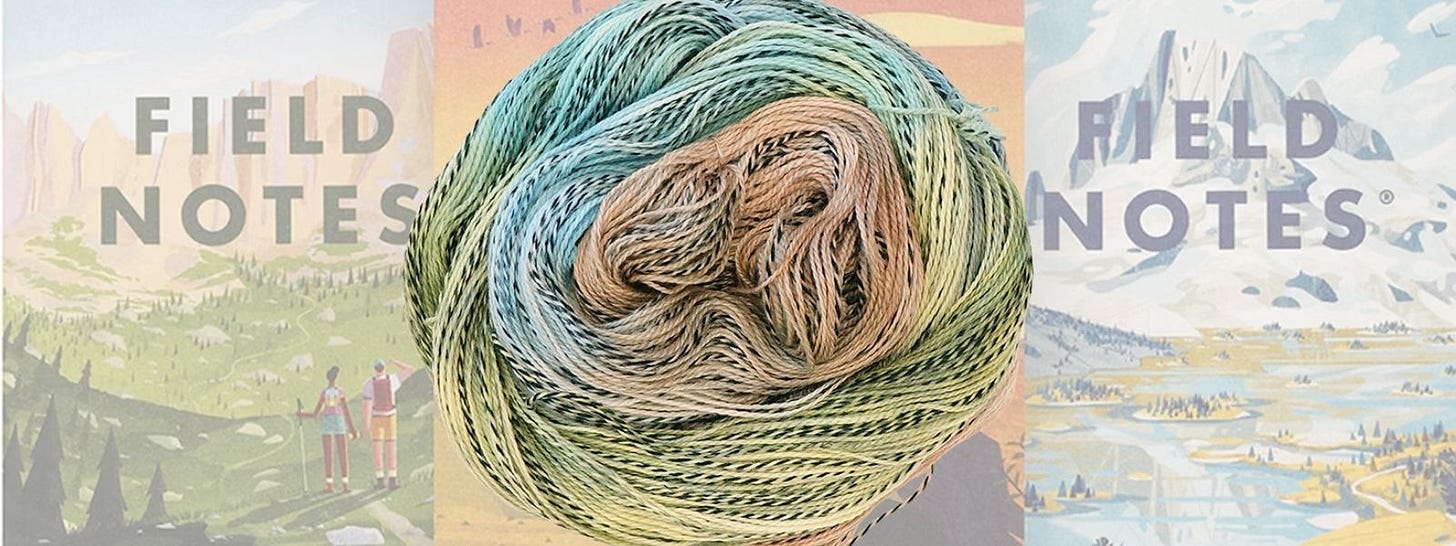
That moment is the best explanation I have for why hand-dyed yarn costs what it does. Not the materials. Not the time. Not even the technique... though all of those things matter and we’ll get to them. It’s that a human being put something of herself into a pan, and it came out the other side recognizable to a stranger who was living that same inspiration from a completely different direction.
You can’t manufacture that. You can only make it.
It starts with the materials, and materials are just the beginning.
Finding the right base yarn isn’t as simple as ordering whatever’s available. It’s understanding how dye takes to different fiber bases, because they are not the same. Merino wool takes color differently than cotton. Cotton takes differently than bamboo. Bamboo takes differently than silk. The same dye, the same formula, the same technique, and you can get wildly different results depending on what you’re working with.
That knowledge comes from research. From sampling. From relationship-building with suppliers whose products you’ve tested and come to trust. By the time a base yarn makes it into your studio as a permanent part of your lineup, it’s already been through a process. The bare-bones cost of the yarn and the dye is maybe twenty percent of the story.
Then there’s the knowledge you’re buying.
Color theory. Chemical reactions. What happens to a color when you change the acid levels in the dye bath. The difference between vinegar and citric acid, and yes, there is a real chemical difference, one that affects how the dye behaves and how the color sets. Knowing that before you start is not intuition. It’s accumulated experience.
More than that: knowing what happens when two colors meet in a wet skein. Whether the place where they touch is going to bloom into something beautiful or turn into a muddy mess. Being able to look at a dye tray before it goes to heat and know, with reasonable confidence, what’s going to come out the other side.
That’s not something you learn in an afternoon. It’s experience compressed into every colorway.
And then there’s the risk.
Every colorway starts with a willingness to try combinations that look wrong in theory and trust your eye anyway. To push past what seems safe and see what happens when you go further... more contrast, more unexpected color pairings, more commitment to a direction that your head says makes no sense.
Beyond the color choices, every technique decision changes the outcome. Pot vs. pan. Tied vs. untied. Twisted versus flat. Each one produces a different result. Each one is a choice, not an accident. That’s artistry in motion, not a formula, not a production run, but a series of intentional decisions made by someone who knows what each one will do.
It’s not manufacturing. It’s art.
Small batch means no two skeins are identical. There’s no machine calibrating the output, no standardized formula ensuring every skein matches the last. The variation is the point. What you’re holding in your hands is the result of human creative decision-making, every choice visible in the skein itself.
Hand dyed yarn is fundamentally different from a mass market product. This isn’t about better or worse... mass market yarn has its place, and absolutely should. It’s different in a way that matters when you’re buying it. You’re not buying something that came off a line. You’re buying something someone made.”
And making something takes more time than you think.
It’s not just dyeing time. It’s also design time. The hours spent thinking through a colorway before a single drop of dye is mixed. Failure time, the batches that didn’t work, the colorways that looked perfect in your head and came out wrong, the sampling that happens before a colorway earns its place in my lineup.
Then there’s everything after: photography, writing, listing. Trying to translate the emotion and the feeling you put into a colorway into a description that communicates it to someone sitting at a computer who isn’t standing in front of you at a festival or a pop-up, holding the skein in their hands, feeling the softness and weight of it. That translation is its own kind of work. And it matters, because for online customers, the words and the photos are all they have.
The everything else that goes into a skein arriving at someone’s door is enormous. And most of it is invisible.
Then there’s the part nobody talks about.
Every skein that goes out into the world carries something the dyer put into it, pride, hope, a little vulnerability. There is real exposure in making something and offering it up and waiting to see if someone else sees what you see. That moment between making and selling is genuinely uncomfortable sometimes. You put something of yourself into the work, and then you hold it up and hope.
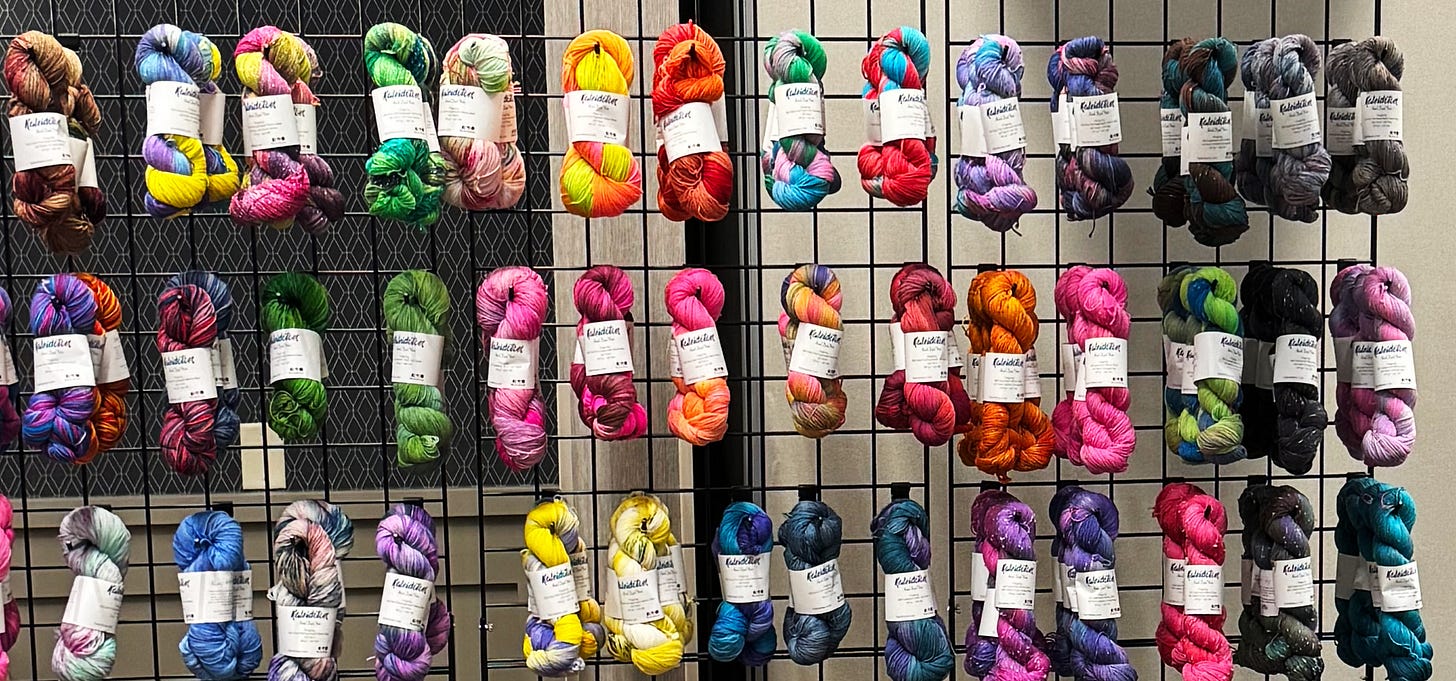
When someone buys a skein, it’s not just a transaction. It’s validation. It’s someone saying yes, I see it too.
And then the magic that happens after. You envisioned it one way. It becomes something entirely different in someone else’s hands, and it’s perfect. Something you made transforms into something you never could have imagined, a project, a garment, a finished object that exists in the world because you took a chance on a color combination and someone else saw the possibility in it.
That’s not a feature of mass market yarn. That’s only possible when a human made a decision, took a chance, and put something real into the work.
The reward in that is beyond measure. It’s the whole reason I do this.
So the next time you pick up a skein of hand-dyed yarn and do the math, know that you’re not just buying fiber and color. You’re buying knowledge, risk, artistry, and time... and something a little harder to name. The feeling that someone made this, and meant it.